Loading gallery...
Loading gallery...
We use cookies to analyse site usage and improve your experience. For more information on how we use cookies, please see our Terms of Use and Privacy Policy .
Browse through our collection of media resources
Brief interventions are recognized by WHO as effective for addressing the risk factors of noncommunicable diseases (NCDs), including smoking, alcohol consumption, insufficient physical activity, unhealthy diets and over- or underweight. There are, however, few data on the use of brief interventions or on the perspectives of health-service providers in the WHO European Region on the barriers to and facilitators of their delivery. This report is part of the BRIEF project of the WHO Regional Office for Europe. The aim of the project is to advance implementation and use of integrated brief interventions for NCD risk factors in primary care in the WHO European Region. The report of this mixed-method study presents the results of a questionnaire-based survey and in-depth interviews with primary‑care providers on three main topics: current uptake of brief interventions by providers; barriers, facilitators and recommendations from providers for effective brief interventions in primary care; and policy recommendations for effective facilitation and implementation of brief interventions.
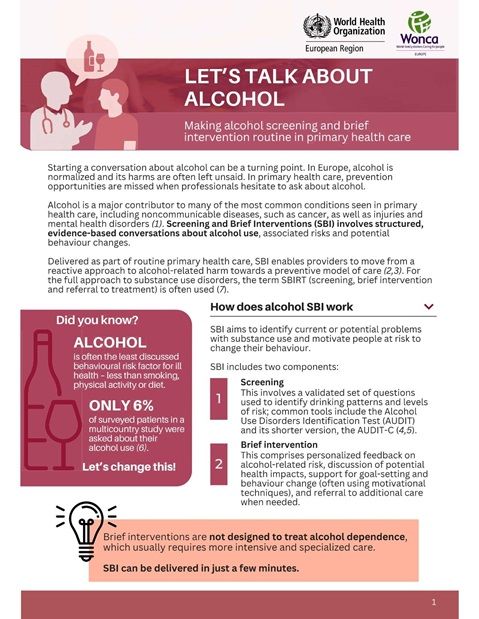
Short 2 pager encouraging alcohol screening and brief intervention to become a standard part of routine primary health care
In 2020, an estimated 741 300 new cancer cases, or 4.1% of all new cancer cases globally, were attributable to alcohol consumption. Alcoholic beverage consumption is a risk factor for numerous other health conditions in addition to cancer. A Working Group of 20 independent international experts, convened by the International Agency for Research on Cancer (IARC) from June to October 2024, reviewed the body of evidence on the effects of selected alcohol policies on reducing alcoholic beverage consumption. Population-level alcohol policy interventions related to (i) taxation and pricing, (ii) physical availability, (iii) alcohol marketing, and (iv) coordinated and other multiple alcohol policy interventions were evaluated. In addition, health care-based interventions (i.e. screening and brief interventions, and psychosocial and pharmacotherapy interventions) were reviewed but not evaluated
Worldwide, in 2020, an estimated 741 300 new cancer cases were attributable to alcohol consumption. This represents 4.1% of all new cancer cases, 6.1% among men and 2.0% among women. A Working Group of 15 independent international experts, convened by the International Agency for Research on Cancer (IARC) from February to May 2023, evaluated the body of literature assessing the effectiveness of reduction or cessation of alcoholic beverage consumption in reducing risk of alcohol-related cancers. The Working Group reviewed and summarized the available epidemiological evidence and provided evidence-based evaluations of the effectiveness of reduction or cessation of alcohol consumption in reducing risk of cancers of the oral cavity, pharynx, larynx, oesophagus, colorectum, liver, and female breast. The Working Group also identified and evaluated the mechanisms of alcohol-related carcinogenesis that may be reversed upon cessation. To complement the evaluations, this publication presents background information on the alcohol-related cancer burden worldwide, the population attributable fraction of alcohol-related cancers, and determinants of cessation.
This report presents a comprehensive global update on the status and progress around the two key indicators set out in SDG health target 3.5: alcohol consumption and treatment coverage for substance use disorders. It sets out eight priority areas where action needs to be taken. Despite some reduction in alcohol consumption and related harm worldwide since 2010, the health and social burden due to alcohol use remains unacceptably high. Younger people are disproportionately affected by alcohol consumption: the highest proportion of alcohol attributable deaths – 13% – in 2019 was among people aged 20-39 years. While we have seen a slight increase in the number of countries adopting national alcohol policies, little progress has been made in implementing the high-impact policy interventions proven to reduce alcohol-related harm, such as impactful pricing policies or comprehensive marketing and availability restrictions. The WHO Global alcohol action plan 2022-2030 sets out these ‘best buys’ and supports countries to strengthen actions on reducing alcohol-related harms, but implementation efforts must be stepped up urgently. The report also highlights another critical gap: access to quality and ethical treatment for substance use disorders is still largely limited or unaffordable for those most in need. This affects almost half a billion of people worldwide who live with alcohol or drug use disorders. Stigma, discrimination and misconceptions about the efficacy of treatment contribute to gaps in health services and low prioritization of substance use disorders by health and development agencies. We are not on track to achieve significant progress for SDG target 3.5 unless we accelerate action now. WHO remains committed to working with governments, international partners, civil society organizations and, as appropriate, other stakeholders to make real and measurable progress towards these targets. Given the heavy health and social burden that psychoactive substance use continues to have on people, their families and communities across the world, efforts to reduce psychoactive substance use must be a public health priority
This manual is a companion to ‘The ASSIST linked brief intervention for hazardous and harmful substance use: manual for use in primary care’1 and is based on ‘The Alcohol, Smoking and Substance Involvement Screening Test (ASSIST): Guidelines for Use in Primary Care. Draft Version 1.1 for Field Testing’2 . The purpose of this manual is to introduce the ASSIST and to describe how to use it in health care settings – particularly community based primary health care settings – to identify people who are using substances, so that a brief intervention (or referral) can be provided, as appropriate. The manual will describe: ❙❙ rationale for screening and brief intervention; ❙❙ problems related to substance use; ❙❙ the development and validation of the ASSIST; ❙❙ how to use the ASSIST (administration, scoring and interpretation of scores); ❙❙ motivational interviewing tips to facilitate the process of asking about substance use; ❙❙ how to incorporate ASSIST screening in everyday practice. Additional information is included in the Appendices to the manual: ❙❙ Appendix A includes a copy of the ASSIST questionnaire. ❙❙ Appendix B includes a copy of the ASSIST response card for clients. ❙❙ Appendix C includes a copy of the ASSIST feedback report card for clients. ❙❙ Appendix D includes a copy of the risks of injecting card for clients. ❙❙ Appendix E provides information about how to adapt the ASSIST for other languages and cultures and to take account of the local situation. ❙❙ Appendix F provides answers to the selftesting questions posed in Chapter 11 ‘Good practice in ASSIST questionnaire administration’. ❙❙ Appendix G provides two scripted ASSIST examples for practice in role play. A companion document ‘The ASSIST-linked brief intervention for hazardous and harmful substance use: manual for use in primary care’1 explains how to link the ASSIST to a brief intervention to help clients reduce or stop their substance use.
This manual is a companion to ‘The Alcohol, Smoking and Substance Involvement Screening Test (ASSIST): manual for use in primary care’ 1 and is based on ‘Brief Intervention for Substance Use: Guidelines for Use in Primary Care. Draft Version 1.1 for Field Testing’2 . The purpose of this manual is to explain the theoretical basis and evidence for the effectiveness of brief interventions and to assist primary health care workers in conducting a simple brief intervention for clients whose substance use is putting them at risk. Together with the companion manual 1, this manual presents a comprehensive approach to screening and brief intervention which is tailored to the specific circumstances of primary care and is designed to improve the health of populations and client groups as well as of individuals. This manual describes: ❙❙ the rationale for brief intervention in primary care; ❙❙ a model of behaviour change; ❙❙ the components of brief interventions that work principles of motivational interviewing and essential skills; ❙❙ how to link the ASSIST screening procedure with a brief intervention; ❙❙ how to give feedback to clients; ❙❙ how to conduct brief intervention for people at moderate risk; ❙❙ examples of ASSIST-linked brief interventions; ❙❙ how to help clients who inject drugs; ❙❙ how to address multiple substance use; ❙❙ how to give longer or recurrent interventions. Although the manual is particularly aimed at primary health care workers, it may also be useful for others who work with high-risk clients or clients who are more likely to engage in drug use such as hospital physicians and nurses, midwives and obstetricians, social workers, prison workers and community correction workers.
This video demonstrates an Alcohol Screening and Brief Intervention (SBI) delivered by a primary health care provider during a telehealth follow-up visit with a 16-year-old patient. After sharing negative STD results, the clinician asks permission to review the patient’s substance use questionnaire and explains that the discussion is confidential, supportive, and focused on helping her make informed choices. Using a calm, non-judgmental approach and motivational interviewing techniques, the provider explores the adolescent’s drinking patterns (frequency, type of alcohol, number of drinks per occasion), reasons for drinking (relaxation, socialising, fitting in), and warning signs such as memory lapses and heavy episodic drinking. The clinician provides clear information about the specific risks of alcohol use in adolescence, including effects on brain development, injury risk, sexual assault, and sexually transmitted infections. The conversation connects alcohol use to a recent episode of unprotected sex, helping the patient reflect on how drinking influenced her decision-making. The provider explores ambivalence, assesses readiness to change using a 0–10 scale, and supports the patient in developing a practical plan: limiting intake, tracking drinks, involving a trusted friend for accountability, and committing to condom use and avoiding sex when intoxicated.
This video demonstrates a brief alcohol intervention delivered by a behavioral health team member in a primary care setting following an annual screening. The patient reports drinking daily after work, often consuming four or more beers, with episodes of heavier drinking that lead to embarrassment, guilt, hangovers, and regret. Through open-ended questions and reflective listening, the clinician explores the patient’s drinking pattern, triggers (after-work socialising), and consequences (loss of control, doing embarrassing things, difficulty functioning the next day). Although the patient does not identify as “an alcoholic” and does not experience morning withdrawal symptoms, she expresses concern about repeated episodes of overdrinking and a desire to “drink like other people.” The provider reviews the screening results, explaining that her score places her in the highest risk category on the alcohol risk pyramid, where harmful consequences are more likely and additional support is often recommended. While abstinence is presented as the medical recommendation at this level of risk, the clinician emphasizes patient choice and autonomy. Using a readiness-to-change scale (0–10), the provider elicits motivation for change, including a recent embarrassing episode at a work event and a desire to stop regrettable behaviour. The patient agrees to a facilitated referral to a specialized treatment service for further assessment. The clinician offers to call the intake counselor together before she leaves and schedules a follow-up appointment to maintain support. The video models how SBIRT can progress from brief intervention to referral to treatment (RT), emphasizing empathy, autonomy, and collaborative decision-making when alcohol use is causing significant harm.
This video demonstrates an Alcohol Screening and Brief Intervention (SBI) delivered by a primary care provider to a 60-year-old patient during a visit to review antidepressant medication. As part of routine care, the patient completed the AUDIT screening tool, which identified alcohol consumption above recommended limits. The clinician reviews the screening results in a neutral, non-judgmental manner, clarifying drinking patterns (four or more times per week, typically three drinks per occasion, sometimes finishing a bottle of wine). The provider explains low-risk drinking guidelines for women (no more than seven drinks per week) and discusses health risks associated with higher consumption, including cancer, liver disease, insomnia, and worsening depression. Using motivational interviewing techniques, the provider explores the patient’s reasons for drinking (to relax, cope with low mood, make evenings more enjoyable) alongside concerns (guilt, drinking more than intended, feeling worse afterward). The conversation connects alcohol use with depressive symptoms and highlights how alcohol may interfere with treatment. Through a readiness-to-change scale (0–10), the patient expresses strong motivation to reduce intake. Together, they agree on a realistic harm-reduction goal (reducing to two drinks per night), identify practical strategies (keeping less wine at home), and explore alternative relaxation methods such as reading, watching movies, and taking baths without alcohol. The visit concludes with encouragement and a planned follow-up.
This video presents a lived-experience perspective on substance use and recovery, illustrating how screening and clinician engagement can influence a patient’s path toward treatment. The speaker describes a long history of substance use that began in adulthood with cannabis and cocaine, progressed to methamphetamine, prescription opioid dependence after dental procedures, and eventually heroin use. Alcohol also became a central part of daily life, affecting professional functioning and relationships. Despite serious consequences—including DUIs, escalating substance use, and interpersonal difficulties—the speaker explains that healthcare providers rarely asked directly about alcohol or drug use. Questions focused on symptoms such as anxiety or depression, but substance use itself was never explored. The speaker reflects that being asked directly about substance use or completing a screening questionnaire might have helped initiate earlier recognition of the problem. The narrative highlights several important themes for clinicians: Value of routine screening: Written screening tools can help patients disclose substance use more honestly and allow clinicians to open a supportive conversation. Importance of clinician engagement: Patients may benefit from providers who discuss results, offer feedback, and connect them with treatment resources. Role of prescribing practices: The speaker describes how easy access to opioid prescriptions contributed to dependence and suggests that careful prescribing and limits may reduce risk. Recovery as a process: The speaker notes that mandated treatment was not helpful until they personally chose to engage in treatment. Supportive clinician relationships: A trusting relationship with a physician who understands addiction, responds non-judgmentally to relapse, and celebrates progress has been central to long-term recovery. The video emphasizes a key message for healthcare professionals: asking about substance use—openly and routinely—can open the door to life-saving conversations and support for recovery.
This video demonstrates a brief alcohol intervention delivered by a primary care provider to a 40-year-old patient during a follow-up visit for ADHD management. As part of routine care, the patient completed the AUDIT screening tool, which identified weekend drinking above low-risk guidelines. The clinician reviews the screening results in a respectful, non-judgmental manner, clarifying that the patient typically drinks two to three days per week, consuming five to six (or more) beers per occasion. When the patient questions whether this is “too much,” the provider avoids confrontation and instead explores the patient’s own definition of heavy drinking. The clinician explains national low-risk drinking guidelines for men (no more than 14 drinks per week and no more than four per occasion) and introduces the concept of binge drinking. Short- and long-term health risks are discussed, including injury, impaired driving, cardiovascular disease, cancer, liver disease, and mental health effects. Using motivational interviewing techniques, the provider explores what the patient likes about drinking (taste, social connection, relaxation) and what concerns him (potential health risks). Although the patient is not ready to commit to change, the clinician supports reflection by asking what consequences might prompt reconsideration. The visit concludes with educational materials and agreement to revisit the topic at a future follow-up. The video models how SBI can be integrated into adult primary care, including situations where a patient is ambivalent or resistant, emphasizing respectful dialogue, harm awareness, and ongoing engagement rather than immediate behaviour change.
Showing 1–12 of 92 results
